Syrian Falafel? Mamoun's Damascus Roots Since 1971

By Mamoun's Falafel · Updated November 18, 2026
If you're searching for Syrian falafel, Mamoun's Syrian roots start in Damascus: founder Mamoun Chater emigrated from Damascus, Syria, and opened his falafel shop in Greenwich Village in 1971.
Short answer: Mamoun's Falafel was opened in 1971 at 119 MacDougal Street by Mamoun Chater, a Syrian immigrant from Damascus. Mamoun's says its falafel is a family recipe from the founder, and the menu describes it as finely ground chickpeas, onions, parsley, garlic, and spices, deep fried into semi circles. Theories of falafel's origin differ; NPR reported that Egyptian-style falafel is made with fava beans, and Mamoun's makes its falafel with finely ground chickpeas.
Table of Contents
- Mamoun's Syrian Roots at a Glance
- Where Does Falafel Come From?
- Is There One Syrian Falafel?
- How Is Mamoun's Falafel Made?
- When Did Mamoun Chater Open His Falafel Shop?
- From One Shop to Eight Stores
- How to Order Mamoun's Falafel
- Where to Eat It
- Frequently Asked Questions
- References
1. Mamoun's Syrian Roots at a Glance
| Detail | What the sources say |
|---|---|
| Founder | Mamoun Chater, who emigrated from Damascus, Syria |
| First store | 119 MacDougal Street, Greenwich Village |
| Opened | 1971 |
| First shop's size | About 200 square feet |
| Falafel | Chickpeas, onions, parsley, garlic, and spices; deep fried into semi circles |
| Recipe | A family recipe from the founder; kept secret |
| Run by | Mamoun's four sons, per 2019 and 2020 reports |
| Stores today | Eight, in New York, New Jersey, and Connecticut |
Sources: Retail & Restaurant Facility Business (2019), Village Preservation (2020), and mamouns.com, checked November 13, 2026.
2. Where Does Falafel Come From?
Its origin is disputed. Speaking to NPR, falafel maker Ramzi Totari named Egypt as the likeliest birthplace, while Claudia Roden said no one can be certain of the ancient history.
NPR's 2012 report gave more than one theory of where falafel began. In it, Hana Baba described falafel as found in cafes and homes all over the Middle East and parts of Africa, and set out to learn how recipes differ by visiting falafel makers in California.
Her first stop was Ramzi Totari, a falafel maker born in Nazareth, who told her the dish most likely originated in Egypt. At an Egyptian-style restaurant in San Francisco, she learned that Egyptian falafel, which most Egyptians call taameya, is made with fava beans, not garbanzo beans (chickpeas).
The ancient history is murkier. Cookbook writer and cultural anthropologist Claudia Roden told NPR that traces of fava beans have been found in pharaohs' tombs, and some believe tomb paintings show cooks making falafel, but no one can be sure. Another theory, NPR reported, holds that Egypt's Coptic Christians created the dish as a meat substitute during Lent.
The beans are where styles split. NPR suggested that why Egyptians use fava beans and others use garbanzo beans may have more to do with which crops were available than with taste:
| Style | Main bean | Source |
|---|---|---|
| Egyptian (taameya) | Fava beans | NPR, 2012 |
| Lebanese (one cook's recipe) | Fava beans and garbanzo beans together | NPR, 2012 |
| Mamoun's | Finely ground chickpeas | Mamoun's menu |
Roden's own view, as NPR quoted it: "It's the way you were brought up eating it that means everything to you."
3. Is There One Syrian Falafel?
The NPR report covered Sudanese, Egyptian, Lebanese, and Palestinian/Israeli styles but did not mention Syria, and no source we opened defines a single Syrian falafel recipe. What we can say is that Mamoun's falafel is a chickpea falafel: the menu lists finely ground chickpeas first.
Syrian cooks have carried falafel abroad. A 2025 Smithsonian magazine story on Syrians who settled in Berlin quoted a Visit Berlin spokesperson saying that Syrian cuisine, "especially shawarma, falafel and sweets," has become part of the city's food landscape.
We're careful with the label. No source we found describes one official "Syrian falafel" recipe, and Mamoun's doesn't claim its falafel is one. What Mamoun's does say, on its falafel recipe page, is that its falafel recipe is a family recipe from founder Mamoun Chater, who emigrated from Damascus, Syria, and that the exact recipe is a trade secret.
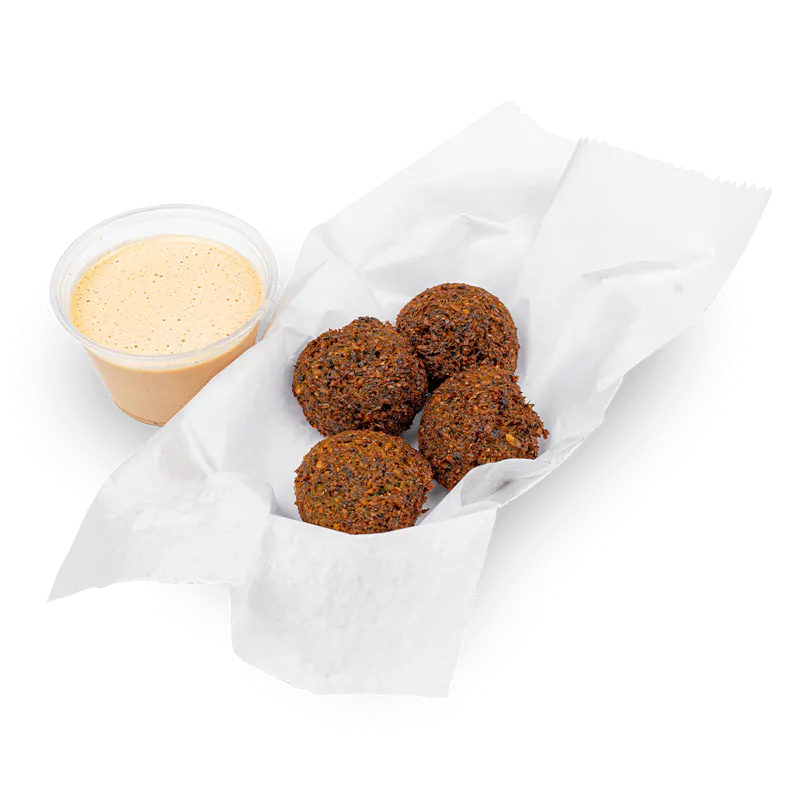
The falafel side: four pieces.
4. How Is Mamoun's Falafel Made?
The Mamoun's menu gives the falafel's ingredients in one line: finely ground chickpeas, onions, parsley, garlic, and spices, deep fried into semi circles. That's all Mamoun's has published.
- The spice mix is secret. Village Preservation, writing in 2020, said not to ask about the special spices and herb mix behind Mamoun's green falafel, because it remains a secret. The hot sauce recipe is secret too.
- It's made from scratch. Mamoun's history page says everything it serves is made from scratch with natural ingredients, imported spices, and signature recipes.
- It was centrally made as of 2019. In 2019, Retail & Restaurant Facility Business reported that the Chater brothers built a 10,000-square-foot commissary for quality control of Mamoun's proprietary recipes, and that Mamoun's makes its family recipes from one centralized facility.
- It's vegan and gluten-free. The menu gives the falafel the vegan mark, and the falafel side the gluten-free mark. The home page says the namesake falafel is vegan and gluten free.
If you want to make falafel at home, our easy authentic falafel recipe walks through a traditional recipe. It is not Mamoun's own recipe, which stays a family secret.
5. When Did Mamoun Chater Open His Falafel Shop?
According to Village Preservation, Mamoun Chater opened his shop in 1971 on MacDougal Street, the street his family had moved to in 1969, after working at an Armenian grocery store on the same block. Greenwich Village in the early 1970s was home to a small but prominent Arab community, Village Preservation wrote, and the local Lebanese, Syrian, and other Arab residents were already familiar with the food Mamoun would serve. Falafel is commonplace now, the article added, but "back then it was entirely new."
Mamoun's history page calls the shop the oldest falafel restaurant in New York and one of the first Middle Eastern establishments in the United States. It also quotes the Village Voice in 1976: "Kissinger could take a lesson in diplomacy here…"
His son Galal Chater told Village Preservation that his father's philosophy was simple: make and serve good food that is consistent, and be nice. His son Hussam Chater told Retail & Restaurant Facility Business: "It's a traditional immigrant story." He said his father came to the country very poor and started the business to support his family.
6. From One Shop to Eight Stores
Retail & Restaurant Facility Business laid out the timeline in 2019:
| Year | Store |
|---|---|
| 1971 | Greenwich Village, a 200-square-foot flagship |
| About 5 years later | New Haven, Connecticut, designed for Mamoun's brother to run |
| 2004 | East Village, St. Marks Place |
| 2011 | Hoboken |
| 2012 | New Brunswick |
| 2014 | Princeton |
Mamoun's four sons, Nedal, Galal, Kinan, and Hussam, worked alongside their father and gradually took over the business, the magazine reported. Mamoun Chater died in December 2015. Today the Mamoun's locations page lists eight stores: Greenwich Village, the East Village, the Upper West Side, and the Upper East Side in Manhattan, plus Hoboken, New Brunswick, Princeton, and New Haven.
7. How to Order Mamoun's Falafel
Sandwiches come in a pita with lettuce, tomatoes, onions, and tahineh sauce. Plates come over salad or seasoned rice, with tahineh and a pita.
| Order | What's in it |
|---|---|
| Falafel sandwich | Falafel in a pita |
| Classic | Falafel and hummus |
| West Village | Falafel, baba ganouj, and pickles |
| East Village | Falafel, hummus, tabbouleh, and olives |
| Manhattan | Falafel, hummus, baba ganouj, tabbouleh, pickles, pickled turnips, and olives |
| Macdougal | Shawarma and falafel |
| Bleecker | Chicken kebob and falafel |
| Falafel plate | Falafel over salad or seasoned rice |
| Combo plate | Falafel, hummus, and baba ganouj |
| Falafel side | 4 pieces |
The Macdougal shares its name with MacDougal Street, where the original store is. For a group, the catering menu has a Falafel Tray of 10 or 24 half sandwiches, a Falafel Station of about 75 pieces, and a 30-piece falafel side tray.
8. Where to Eat It
For the falafel that started on MacDougal Street, the original store is still at 119 Macdougal Street, open until 4 am on Friday and Saturday, according to its store page. The other Manhattan stores are at 30 St. Marks Place, 508 Columbus Avenue, and 1105 Lexington Avenue. Our guide to where to get falafel in NYC has hours for each.
9. Frequently Asked Questions
Is Mamoun's falafel Syrian?
Mamoun's founder, Mamoun Chater, emigrated from Damascus, Syria, and Mamoun's says its falafel is his family recipe. We don't claim it is the one Syrian recipe; no source we found defines one.
Where is falafel from?
Theories of its origin differ. A falafel maker told NPR the dish most likely originated in Egypt, where it's made with fava beans, and Claudia Roden told NPR that no one can be sure of its ancient roots.
What is Mamoun's falafel made of?
Finely ground chickpeas, onions, parsley, garlic, and spices, deep fried into semi circles, according to the menu.
When did Mamoun's open?
In 1971, at 119 MacDougal Street in Greenwich Village.
Who runs Mamoun's now?
Mamoun Chater's four sons took over the business, Retail & Restaurant Facility Business reported in 2019.
Can I get Mamoun's falafel recipe?
No. Mamoun's says the exact recipe is a trade secret, and Village Preservation says the spice and herb mix remains a secret. Our falafel recipe page has a traditional recipe to try at home.
Is Mamoun's falafel vegan and gluten-free?
The menu marks the falafel vegan and the falafel side gluten-free, and the home page says the falafel is vegan and gluten free.
10. References
- Katie Lee, "All in the Family", Retail & Restaurant Facility Business, November 19, 2019. Founder from Damascus, Syria; 1971 opening; store timeline; four sons; December 2015; commissary; Hussam Chater quote.
- Harry Bubbins, "Business of the Month: Mamoun's Falafel, 119 MacDougal Street", Village Preservation, January 10, 2020. Syrian immigrant; 1969 move; Armenian grocery; Arab community; secret spices and hot sauce; founder's philosophy.
- Mamoun's Falafel, History. Oldest falafel restaurant in New York; Village Voice 1976 quote; made from scratch.
- Mamoun's Falafel, "Easy Authentic Falafel Recipe: Step-By-Step". Family recipe from founder; trade secret.
- Mamoun's Falafel, Menu. Falafel description, sandwiches, plates, dietary marks (checked November 13, 2026).
- Mamoun's Falafel, Home page. Falafel vegan and gluten free.
- Mamoun's Falafel, Catering. Falafel trays and station.
- Mamoun's Falafel, Locations and Greenwich Village store page. Eight stores; address and hours.
- Hana Baba, "When It Comes To Falafel, The Flavors Of Home Can Vary", NPR, October 13, 2012. Disputed origin; Egypt as likely origin (per a falafel maker); fava beans in Egyptian taameya; Lebanese fava-and-garbanzo recipe; Claudia Roden quotes.
- Jenna Kunze, "How Shawarma Became a Soul Food of Syria's Diaspora in Berlin", Smithsonian magazine, October 3, 2025. Syrian falafel in Berlin.
About Mamoun's Falafel. Family owned and operated since 1971 in Greenwich Village, Mamoun's is the oldest falafel restaurant in New York, with locations across New York, New Jersey, and Connecticut.
Hours and menu items were taken from mamouns.com on the date above and may change.